
EV Chronicles #62 - First Trip to Florida with Cargo Box (4th Overall Trip)

We just returned from our 4th trip to Florida (to Walt Disney World) via driving one of our EVs. Our first two trips were in our 2021 Model Y and the last two trips in our 2025 Polestar 3. This post is mostly going to be about comparing the Polestar 3 with the Cargo Box to our previous trips, but I will interject a few comments about the overall trip for this 4th trip to Florida.
The major difference on this trip was that had 4 adults in the car, with a week's worth of stuff, snacks, and the like, so it was necessary to put the Thule Cargo Box on top of the car for the trip. We were able to get 2 large suit cases, a large duffle bag, and a sleeping bag into the Cargo Box. We could have likely stuffed a few more items in there if we really needed to. As I have mentioned in my previous post (#61), I believed the impact to energy consumption could be as much as 20% or more and could result in upwards of 30 minutes or more of additional time charging the vehicle during the trip, I thought that we might even need to add an extra charging stop. So let's get into the details.
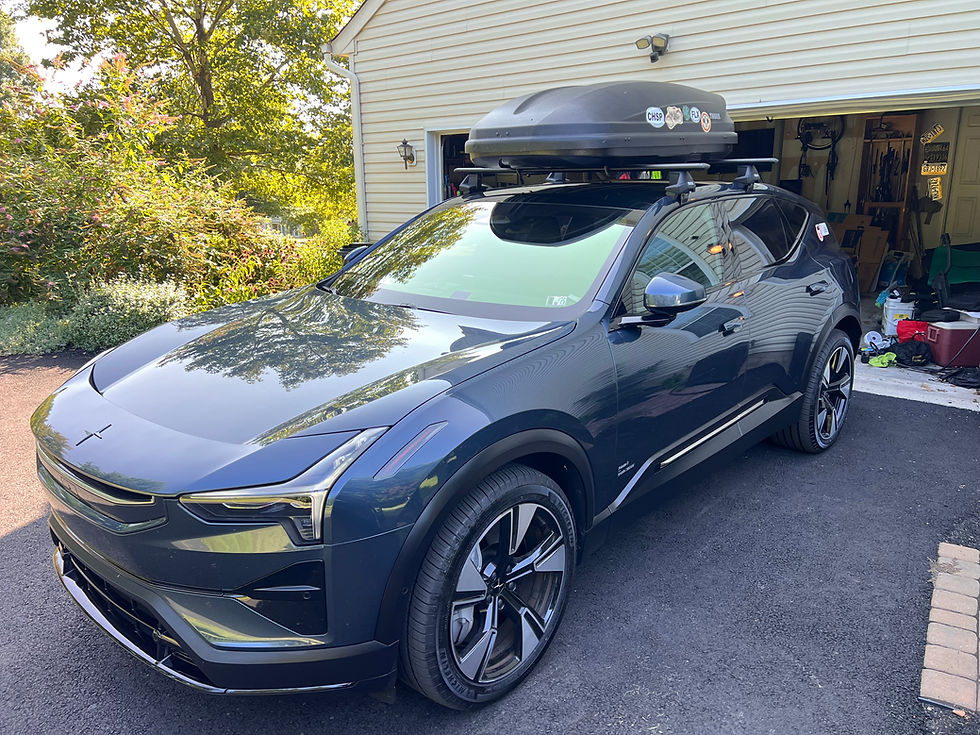
Picture from earlier this summer
So, it appears that my assessment in post #61 was mostly proven to be accurate. I basically asserted that having the roof box on top of the vehicle would make very little difference and that other factors like traffic and weather would most likely dominate the trip, and I think that the data that I now have from 4 different EV trips to Florida mostly supports that claim. Here is what I learned after analyzing the data from this last trip and comparing it to the other 3 trips:
The Polestar is a better road tripping vehicle than the Model Y
On average, we spent 35 minutes LESS per leg charging the Polestar 3 than the Model Y.
Even though our trips in the Model Y were slightly longer in miles because of going out of the way to pick up family members both times that we took the Model Y on this journey. This added about 100 miles to the trip in each direction. Even with the extra 100 miles, I'd say the Polestar 3 was the winner here in charging time.
Tesla Autopilot and FSD is definitely better than Polestar's Pro Pilot, but the Polestar is a way more comfortable vehicle. A wash.
Tesla's navigation is better (see more below)
Polestar 3 - Thermal issues during our July 2025 trip
During our trip in July in the Polestar 3, we had extreme Heat on the East Coast. Temps were basically near 100 from PA all the way to Florida in the afternoons. At that time, our Polestar had a defect (now fixed) that resulted in poor HVAC performance which also resulted in slower than nominal charging sessions during this trip, particularly once we got into the afternoons.
I estimate that the impact from the thermal issues were nearly the same as the impact from having the cargo box on top of the vehicle, effectively resulting in our charging sessions needing to be longer. In the case of the heat, more time to get the energy we needed, in the case of the cargo box, more time was needed to add extra energy for the next segment of the trip. ~30 minutes for each leg of the trip, or about 4 extra minutes at each of the 7 charging stops.
I have concluded this since we left at 3:30AM to head to Florida during the first trip, and for the most part, the thermal issues were not an issue until our last 2 or 3 charging sessions on that first day. That first day had 30 minutes less charging time than the average of the other 3 legs in the Polestar
Polestar 3 - Thule Box Impacts
No impact to the number of stops - 7 Charging stops in each direction with or without the box
With the Cargo Box, it looks like we basically just added more energy per stop to make up for the inefficiencies which means we ended up spending about 4 extra minutes on average at each stop or a total of 30 minutes of extra time on each travel leg.
Traffic and Weather Dominate the total Travel Time
As a result of Torrential Rains and Traffic, one of our 8 legs was well over an hour longer than the average of the other legs.
As a result of leaving home at 3:30 AM on one of our legs, we completely avoided much of the typical traffic around Washington DC. I estimate that we shaved about 30 minutes of travel time off of our trip because of this. There is essentially no way to avoid traffic around DC when driving North / coming home.
Driving North vs. South
For reasons I do not understand, driving South has been less efficient than driving North, by upwards of 10% less efficient. I don't have any solid evidence to suggest why this is the case. I have two theories on this:
3 of our 4 trips have been during times when it was cold at Home. One possibility is that when the car starts out cold, that the first several hours to the first day of the trip, both EVs were working a bit harder to keep the car warm as we headed south. On the return trip, the car already had some built up, stored thermal energy in the batteries and the cabin, thus less energy was needed to get the batteries warm for charging or to keep the cabin warm
One problem is that on our July trip, this was still experienced, yet temps in PA when we started were in the 70's.
My other theory is that the prevailing winds on the east coast during our drives move up the coast? Thus, while driving South, we might be driving INTO the wind and coming North might put the wind to our backs.
Polestar Navigation - Google Maps
Google Maps in the Polestar performed well on this trip. It didn't have any issues through SC and GA like we had back in July. It generally planned out the trip with reasonable charging stops.
My biggest issue with Google Maps is that they don't make it simple to find and add charging stops. The search function defaults to searching for charging stations locally to your current location, thus finding charging stations that are 1-2 hours down the road is a little tricky. It helps to know in advance which charging stations you might want to stop at.
And then, once we added charging stops into the plan, it seemed to struggle at times to recompute the rest of the trip. On a couple of occasions, we had to delete the current trip out of the computer and re-entered the next charging stop and hotel or home as our planned destination to see what additional charging stops it would come up with.
Because we like to stop every 90-120 minutes or so, in any EV, there is a lot of manual manipulation with charging stops that are auto calculated. This seemed easier to do in the Tesla vs with the Google Maps application.
The estimated State of Charge at arrival throughout the trip was very accurate. It adjusted after our first hour or so of driving to account for the Box on top of the vehicle. We generally planned to have at least 10% at our next destination at a minimum and that worked really well for us. On one segment, I got over confident and left a charging session with 7% estimated at arrival at the next stop...and then I was driving REALLY fast. At one point, our SOC at arrival was down to 1% but I managed to get it back up to 5% by slowing down a bit.
So, in the Polestar 3, this is what the typical trip from our home in SE PA to Walt Disney World, via I-95 typically looks like for us:
1025 miles door to door (up to 30 extra miles possible depending on location of Hotel stops, driving around for dinner, and stops in and around Orlando when we arrive before going to our resort)
16:15 Driving Time
We can save about 30 minutes headed south if we leave in the middle of the night to avoid DC traffic in the morning, tough to avoid traffic coming home.
Charging Time: 1:50
7 Charging stops - plus 1 overnight charging stop (which is NOT included in the charging time calculation)
Abetterrouteplanner.com suggests that this is the fastest way to travel in the Polestar and agrees on the number of stops and time of charging, except it suggests that the first segment of the day is a 3-4 hour drive which is nuts, so we always add the 7th stop in about 1.5 hours from departure in the AM if we can.
Assumes AM Departures at or near 100% from Home or Disney
Charging upon arrival at Disney or Home not included as a charging stop or included in charging time
Thule Cargo Box added about 30 minutes of charging to the entire trip
Based on our 4 trips to Disney so far, here is my takeaway:
Driving to Florida SUCKS no matter what, even if we were in a gas vehicle. Not sure we'll be doing it again anytime soon. We are planning to fly there on our next trip and might look into taking the Amtrak Auto Train sometime in the future. Unfortunately, the Auto Train is NOT very cheap, but taking it would avoid us actually driving all but about 4 hours of the trip.
When we stop on a road trip is dictated MORE by our need to use the restroom or to get some food. This is typically about 1.5 to 2 hours between stops.
I wish the route planner allowed us to enter this in as an input into their planning algorithms
I have found that when these charging stops are close to 15 minutes each (Polestar 3 without a cargo box), it really doesn't feel like driving in an EV is having any impact on the overall drive duration. It adds about 5 minutes per stop at most for any stop where you weren't getting food which is only about 4 out of the 7 stops. During these 3 food stops, we often achieved much higher SOCs, cutting the time down needed at the next couple of charging stops, and then 6 hours has gone by and you need another meal again.
In its optimal condition, the Polestar 3 is a road tripping machine. With the Cargo Box on the Polestar, the Model Y, or the degraded charging caused by the extreme heat when we were in the Polestar this July, charging sessions were generally spaced the same, but had to be slightly longer in duration. 5 extra minutes per stop doesn't sound like much, but for some reason, it just "feels" longer and after a long day of traveling, it "feels" like we are really being slowed down by taking the EV over a gas vehicle.

Comments