
EV Chronicles #65 - Polestar 3 Winter Efficiency

Almost two years ago, I wrote a blog about the Truth and Lies about EVs and Cold Weather (https://marcepochet.wixsite.com/the-ev-chronicles/post/tesla-chronicles-46-truth-and-lies-about-evs-and-cold-weather). Two years later, and sadly, not much has changed.
In my opinion, that was one of my best, most details blogs about driving an EV in the winter, so I suggest reading it (again if you read it the first time) if you want to know more about all the factors that go into range loss in EVs due to cold weather. For those that don’t want to read it, here is the summary:
EVs lose range it the winter, but the amount of the loss is highly dependent on the EV design (heat pump) and each driver’s use case (warming car while plugged in or not, many short drives vs. one long drive, etc.)
EVs (might) charge slower on road trips when temperatures drop
The Media likes to pump the public with sensational story titles to drive clicks to their websites about how EVs don't work in the winter or have no range, when the reality is they work incredibly well in the winter.
For those that are here ONLY for my analysis of the Polestar 3 Winter Efficiency, jump further down in this blog below the divider about halfway to the bottom of this post.
So, as I said, in two years, not much has changed in the EV world when it comes to EV range loss in winter conditions. To the best of my knowledge, there have been no technology improvements in EVs that improve winter efficiency beyond the fact that it seems like just about every EV coming to market these days now have Heat Pumps rather than resistive heating (think toaster coils). Honestly, we are talking about the usage of energy which has to come from somewhere, to produce heat. EVs are so efficient with turning energy into motion, that there is very little residual, waste heat to harvest for heating up the cabin unlike a gas vehicle. So if the energy has to come from the battery, then of course, an EV is going to not have as much stored energy that can be used for driving. Its basic physics. Yet, to this day, people seemed to be shocked by this, particularly EV owners.
Given the amount of information available in less than a second with a quick Google search on this matter, it just amazes me that people continue to have limited knowledge about a product that they purchased that is likely the most expensive item they own after their home (if they are homeowners). Yet, here we are in 2025 as the world and the US is now out of the Early Adoption phase and into the Early Majority (13.5%-50%) phase in terms of transitioning our vehicle purchases over to BEVs (https://rmi.org/electric-vehicles-are-on-the-road-to-mass-adoption/), I continue to see posts on Social Media sites from new EV owners that are claiming they are only getting about 50%-75% of the advertised range of the EV in winter conditions. This is where education of new EV owners and prospective EV owners needs to improve, mostly because it is true. An EV WILL USE MORE ELECTRICITY in the winter. It will use a little more on long drives and it potentially could use a ton more across many short drives over several days. I would like to unpack this post, because it is an example of an EV owner not understanding the numbers and thus being somewhat surprised by it. After I unpack this post, I will then update everyone on my experiences so far in winter conditions in my 2025 Polestar 3 as I have started to collect some energy usage metrics through our first cold spell here in Southeastern PA.
So, let’s just start with this example post from Facebook last week on the Polestar 3 Group Page :

Let’s unpack what we are seeing here in hopes that it can help many other current and future EV numbers:
“Car suggested a range of 220 miles”
Every EV has some sort of range number it displays. Many seasoned EV owners affectionately call this the Guess O’ Meter or GOM, because in EVERY EV, this number is totally BS.
In most EVs, this number is an estimate of how far you might be able to drive continuously (no stops), on a flat surface, under ideal temperatures (65-70F), at optimal efficiency speeds (likely 35-45 mph)….and you might also need to drive downhill with a tailwind. NO ONE DRIVES LIKE THIS!... but this is how the EPA computed range of EVs is determined.
Seasoned EV owners completely ignore this number and trust what the trip computer/navigation says your SOC will be at your planned destination. This is because the navigation system can consider things like elevation change, current temperatures (and in some EVs, wind speed and direction), and expected driving speeds to compute realistic consumption numbers. In my 2021 Tesla, I had the display setup to NEVER show this number because it was so useless. Unfortunately, in the Polestar, it is always there but I know to just never look at it.
“I only get 156 miles instead of the reported 220”
The OP is taking the 107 miles they drove using 55% of the battery and projecting that they could have driven 156 miles if they had used the entire 80% of the battery.
This is 70% of the 220 miles that the GOM was telling them, and honestly, this OP likely squeezed as much range out of the battery under the conditions described by adjusting their HVAC settings. I am not sure turning one pedal driving OFF was the best choice.
In my experience this past month, if I simulated the OPs experience (not use my home charger every night), my usable range would likely be about 50-75% of the range I could achieve in ideal temperatures.
“I don’t have a charger at my Condo building”
First, I hope this is something that changes very soon. I am already seeing many of the newer condo complexes in my home region are installing L2 chargers. My son’s apartment complex recently installed 6, L2 chargers. The chargers aren’t free, and the rates are somewhat in line (unfortunately) with the cost of the DCFC chargers in the area, but having that on-site makes EV ownership much more possible for their residence.
Second – I point this out, because the OP (noted later in comments), went SEVERAL Days between charges. Each day consisted of warming up the car, driving to work in the morning, then car sits all day, then another warmup cycle, followed by a drive home. Many EV owners fail to factor into the equation the amount of energy that is required to just warm up their vehicle. Of the 55% of the battery that the OP used during this week, as much as 20% of that was used just to get the car warmed up before driving or the first couple minutes of the drive if they got in the car cold and drove off.
Polestar 3 Winter Efficiency Analysis
It is now mid to late December 2025, and here on the eastern coast of the US, we have experienced now for the last two weeks or longer, a rather unusual cold weather period. We have seen morning temps into the teens and have struggled to get our afternoon temps above 40F. I wish I would have started to collect this data sooner, but on December 9th, 2025, I started to get serious about trying to track my Polestar 3's power usage. After giving some thought to the methodology that I was going to use for this analysis and figuring out the data that is available to me from the Polestar app (not much there), I think I have a pretty good approach.
First, I am planning to use the data from the Polestar Trip Summary app after each of my commutes to/from work over the winter months. This means after each drive, I have to remember to go to this screen in the Infotainment system and take a picture of it. This page (see the below photo example from my coldest morning...sorry it is a little crooked) provides a summary of the total consumption, time of the drive, average speed, and then breaks down the amount of energy (kWh) that was used for 3 categories: Driving, Climate, and Battery care and electronics. This is a great data set to work from to get perform this analysis.
Traffic in our area varies wildly with time of day and precipitation, so I have decided to use the Time of Travel to normalize the data I am collecting to assess the average power (kW) the Climate system is pulling. I don't think that precipitation significantly impacts the Climate systems usage of power by the way. This is based on only two days with roughly the same temperature where it was raining one day and it wasn't the other day. Both days fall within what I consider acceptable error within the data and isn't something I need to model of pull out of the data set. I do think that precipitation influences the amount of power needed by the drive systems to overcome the changes in drag and ground friction.
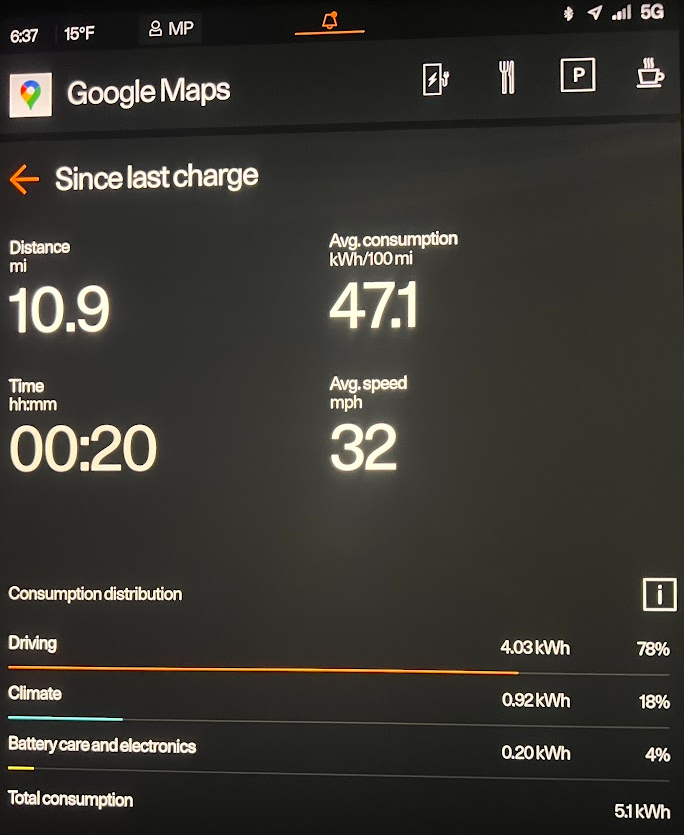
Before getting into the results, I want to talk about my methodology for collecting this data:
The data will primarily come from my daily commutes. I will also collect data from my drives to/from Harrisburg to visit family (separately), but I likely won't get more than about 10 or so total drives logged in that category before the end of the winter.
Note that I am using the term "commute" loosely here as any drive that originates "near" either work or home and ends "near" either work or home. For example, I included a drive from work to the Chiropractor which is just a couple of miles from home.
My commute is about 10-11 miles depending on which route I take near home.
I am only logging commutes where the vehicle had an opportunity to pre-warm before driving. That means these numbers are meant to represent the "steady state" power consumption of the climate control system (heat pump, seats, and steering)
Best that I can tell, even at temps below 20F, it takes less than 10 minutes to achieve steady state climate conditions. I don't start driving on most days until 20 minutes or more after pre-conditioning has started so I am fairly certain I am recording steady state values.
I attempt to record the average temperature over the last 80% of the commute as reported by the car on the infotainment screen. The temperature sensor in the car tends to vary slightly at first until the ambient air has a chance to bring the sensor to steady state. If the temperatures vary more than about 4F (min to max) on any commute, I will not include that commute in the dataset.
Climate will be set to Auto at 68-70, Driver seat to level 1, Steering wheel to level 2.
As noted below, I don't believe seat and steering wheel levels to be significant contributors here and the setting won't matter. Likewise, a 1-2 degree difference in the set temp inside the cabin won't make much of a difference.
Results:
Understand that these results are super preliminary as I have only collected about a dozen drives over the past 10 days, but in those 10 days, I have managed to collect a dataset across a nice range of Temperatures from 15F to 38. Here is my take on the data collected so far:
We just feel warmer in the Polestar 3. When driving in the coldest of weather in the Tesla, it just felt like there was a ton of heat drain through the windows and doors that you could just "feel" (radiant heat loss), even though the climate control system was still putting out plenty of heat. I do not get that same "cold drain" feeling in the Polestar 3. Better insulation and materials used in the Polestar?
The Polestar 3 seems to use slightly less energy in the heat pump than I used in the Tesla Model Y at any given Temperature, which checks with the first point to some extent.
I don't have any extensive analysis to prove this, but I spot checked usage at 15F. About 2.6 kwh in the Polestar and I estimate about 3.0 was used in the Tesla. Over 10% less used in the Polestar.
No Climate energy needed when ambient temperatures are above about 46 degrees. More data is needed but the slope of the line below approaches zero near 46 degrees, and on a commute home this week, temps were in the upper 40's and minimal energy was used by the climate (<10 wH).
In the Tesla, energy usage seemed to go to nearly zero above 50F
Seat and Steering Wheel heating uses nearly zero energy or Polestar doesn't include that energy in the climate category (event though they claim they do)
This is based on ONE commute and a couple of other local drives where temperatures were between 45 and 55 degrees and I still left the heated seat and steering wheel on, and the total climate energy usage was essentially zero.
There is plenty of places for error in my methodology. I have to trust what the car is telling me in terms of current temperature and energy usage and my "computation" of the average temperature approach isn't perfect. I hope to have enough data to have a mean and STD deviation at every temperature by 1 deg F increments at some point in the future.
The dominate heat transfer mechanism at play is forced Convection which can be simply modeled using Newton's Law of Cooling:

According to this equation, the rate of heat transfer is a linear function of the delta temperature between the cabin and the outside ambient temperatures. As such, I believe that an overlayed Linear trend line to the limited data that I have so far in the plot below is a pretty good representation of the physical system.
So, Drum Roll.... here is the estimated climate system power consumption from my commutes.

Most people will look at this data and not be sure how to convert this into Range Loss, so I made some assumptions based on ABRP numbers for a 65 mph drive and computed the % of range lost as a function of Temperature based on Climate power consumption from the linear line fit above + 20% (to account for errors that are clearly observable in the limited data so far). At 65 mph, I am assuming that the Polestar 3 consumes 360 wH/mile. I basically need to convert the kW power usage by the Climate system over to wH/mile value to add to the consumption equation. This is done by taking the number from the curve above, multiplying it by 1000 to convert from kW to W, and then dividing by miles per hour. I then multiplied this number by 1.2 to add 20% to the consumption. To get the values on the curve below, I take the usable pack energy (I assumed 100 kWh) and divide it by the addition of the nominal consumption value plus the climate consumption per mile to get the new range value, and then I use that to compute the range loss as a percentage value.

So, at 15F, with a pre-warmed vehicle, driving at highways speeds would result in about a 12% reduction in range for any drive that doesn't require a DCFC charging stop along the way. If you drive slower, thus more time, a higher amount of total energy will be utilized for the Climate per mile as compared to driving, resulting in even larger range reduction as a percentage. In a weird twist, driving faster in an EV in the winter results in less range loss from Climate system drain.
I have no idea at this time, how much energy a Polestar 3 would utilize for preconditioning the battery for optimal high speed charging in these conditions. I hope to collect some data on that some drives this winter but I can tell you that in my Tesla, I seemed to have experienced much larger than a 10-15% range reduction when Supercharger stops were involved. In the Tesla, I ran a few tests where I saw estimated SOCs at arrival vary as much as 5% or more depending on whether I entered the charger (which caused the vehicle to precondition the battery) or the store at the charger (no preconditioning) as my destination when driving in winter conditions. Stay tuned for a full data analysis later this winter or this spring once I have a chance to collect more data.


Comments