
Tesla Chronicles #33 - Extreme Cold and EVs


Well, the nation was plunged into crazy cold weather in parts of every state in the nation in this last week. Combine this with the ever growing adoption of EVs and the time of year where people are loading up the car and traveling, and you get a whole bunch of frustrated and confused EV owners. There are many stories on the news about EVs with poor range in the winter and extremely slow charging sessions. Most of what you are hearing is irrational FUD (fear, uncertainty and doubt) and some of it has some merit. I'll discuss some of the main issues to help folks understand some of the facts and myths as it pertains to EV ownership in the Winter.
I think I wrote last February about a trip to FLX we took where temps were 0-10F all weekend, and we made it work. I want to talk specifically about two main items that I am hearing about on the internet as they pertain to EVs in extreme cold.... range and charging (slow or not able to).
EV range is Horrible in the Cold / EVs don't have practical ranges in the Winter - True
Many people don't think about it, but our gas powered cars experience significant reductions in our MPG (thus maximum range on a tank of gas in the winter). Warming the car up before driving burns fuel that is not used to get to our destination. Additionally, by the laws of thermodynamics, the larger the temperature difference between the combustion chamber and the surrounding environment, the more inefficient the combustion process will be. More energy from the combustion of the fuel will be transferred to the environment and not into usable propulsion. The thing is, because gas stations are everywhere, no one cares, thinks about it, or even realizes this.
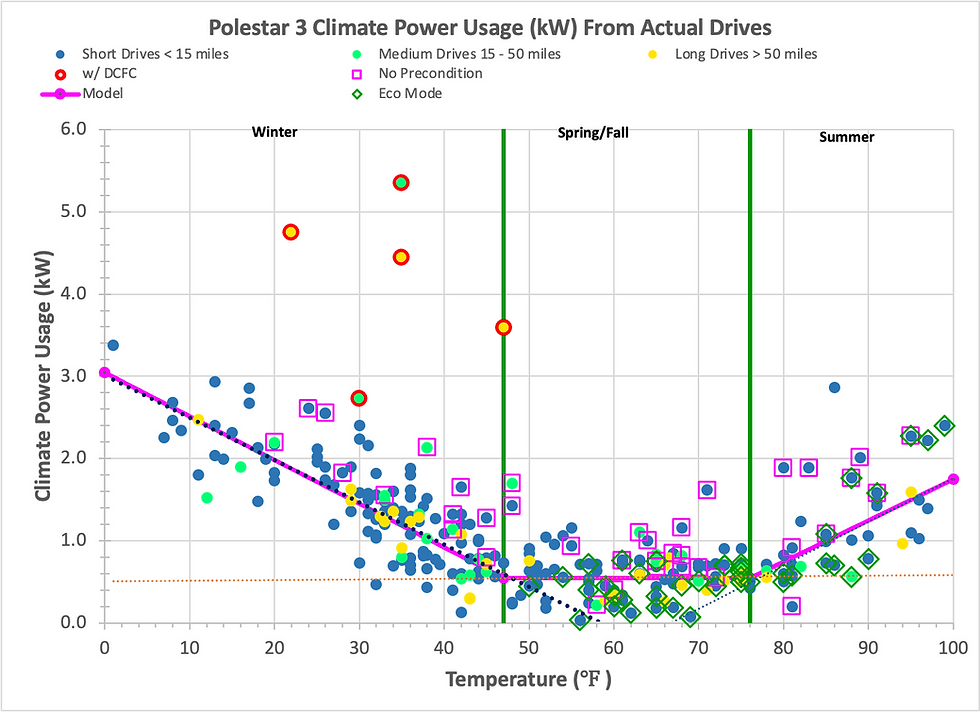
EVs have the same issue when it comes to heating the vehicle before driving. That energy has to come from somewhere. The advantage that an EV has is that if plugged in, that energy can come from an outlet and will not have any impact on the range of the vehicle. But once you start driving, you need to get energy from heating the car from the battery. Let's do some math. It takes about 5-10 kw of power from the battery to keep the cabin warm while driving in near 0F environments. At 50 mph, an EV might burn 300 kWh/mile driven. That is about 15 kw of constant power to keep the vehicle moving. Adding 30% or more to that consumption rate just to keep the passengers warm will significantly reduce the range an EV can travel on a single charge.
My take - this "problem" is being blown out of proportion by the anti-EV world. First and most importantly, for most people's daily commuting, this means that they might have to plug in their car an extra day or two per week in the winter, or if they charge their car every night, a 4 hour charge up becomes a 6 hour charge up. These things have ZERO impact on the lives of EV owners.
The real challenges happen when EV owners are road-tripping in an EV. Traveling at highway speed is already going to be a major impact on the EPA range estimates of a typical EV, but then you add to the equation, the additional power needed for heating the vehicle, then you have conditions that will drive more frequent charging on a road trip (and currently, some places have limited charging infrastructure, making a problem we have even worse). EVs that have advertised 300 miles of range have realistic ranges of 250 miles on the highway, but then you factor in that you only use less than 80% of the battery on a road trip for efficient charging, that range is now down to about 160-200 usable miles between charges on a road trip. Now factor in cold weather, and real world ranges are now down to 120-150 miles. There are still stretches of highway in the US where this just isn't enough to drive an EV about the region.
My experience this past week - Christmas EVE, temps 5-11F, 190 mile trip, used 119% of the battery. In warmer weather, this same trip is generally uses only 80-90% of the battery. I had to stop to charge on the leg towards home, but because of Tesla's excellent battery management features, my charge was flawless at over 200 kw for 7 minutes (added 23kwh or about 30% to my battery). So let's talk about charging in cold weather next.
EVs can't Charge in Cold Weather - Mostly Not true
There have also been reports of EV owners having all sorts of issues with charging in extremely cold weather. Some of this is true, there are cars and chargers that were not working particularly well in the extreme cold. Let's break it down.
First, you must understand that a battery is basically a packaged up chemical reaction. Chemical reactions generally happen faster when the chemicals are warm, and much slower when they are cold. If the chemicals get too hot, they become unstable and .... boom. If the become extremely cold, no chemical reaction is possible and they become the chemical equivalent of a cinder block.
So, batteries in EVs work best when the temperatures are regulated for optimal performance. The optimal temperature range for driving an EV is somewhat lower than the optimal range for charging one. Let them get too cold, then pulling and pushing (regen or charging) energy from the battery gets difficult to do quickly. Max regen is at a lower rate than the fastest charging sessions (by a factor of 2-4), thus the difference in temperature ranges. Let them get too hot, and they rapidly expand, damaging themselves.
Some EV manufacturers have incorporated complex battery temperature management systems (e.g. Tesla and Rivian) but it adds to the cost of the vehicle, and some EV manufacturers have chosen a path of reducing costs by eliminating or providing only basic temperature management systems (Bolt and Leaf).... and then there are many cars that fall somewhere in the middle (ID4 is probably the best example).
In many use cases an EV with basic temperature management systems can be an excellent vehicle choice for many people. It is very important for people to understand the limitations that come with those vehicles, namely, they are terrible road trip vehicles in the winter because the batteries get really cold and there is no way for the vehicle to heat the battery. This results in the next DCFC session is going to be 1-2 hours at a minimum. In extreme cases, these batteries get so cold that the car becomes inoperable and/or unchargeable. I think we have a education issue with these EV owners honestly. The sales teams are not incentivized by explaining the limitation of these vehicles to their potential customers. Doing so would potentially impact their sales, so why would they? This results in an entire population that have unrealistic expections of their EVs.
Some of the more expensive EVs that have the complex battery management systems (often, they have a liquid heat/cooling system) that allows them to have a feature called battery "preconditioning", where the car prepares the battery for fast charging on a road trip by heating it up to an optimal charging temperature. Tesla and Rivian has this feature as well as a few others (EV6 and Ioniq5?). One YouTuber has also recently shown that a Model 3, cold soaked for 2 days in below 0F temps, is capable of using this feature to warm up the battery enough to allow it to start to accept a charge (although it took like 45 minutes for the car to warm up enough...it did warm up). This is a MUST HAVE if you ask me if you plan on driving an EV on a road-trip in COLD climates. The cars will use some power to heat up the battery before arriving at an upcoming charging session. Although this function might use 1-3% of the battery (or about $1 in electricity), it will allow an EV to charge up at nearly maximum charging speeds. Vehicle owners that have EVs without this feature (ID4s, Bolts) are reporting charging speeds that are in the ballpark of 25% of their maximum speeds. A charging session that should be 15-20 minutes now becomes over an hour long. This is unacceptable for my particular vehicle useage, but others have to make that decision based on how they intend to use a car. If you decide to buy a cheaper EV, fantastic, that is awesome that you did that. But please, please do not take that car on the road in extreme cold weather and complain about the experience. You are going to have a terrible trip with charging stops that are as long as your driving legs. Much like it is dumb to take a Honda Civic out on an Off-Road adventure, don't take the wrong EV on a cold weather road trip. These vehicles are not designed for those conditions.
Finally, there have been some DCFC stations across the country that have just stopped functioning when the temps dropped below 0F. This is really unfortunate or many EV owners. First, as far as I know, no Tesla chargers have been impacted, at least not on a massive scale, there may have been a unit or two at some sites that went offline (most sites have a minimum of 8 chargers). One YouTuber got word of a particular brand of CCS chargers not working, so in the middle of the night, he went out driving about Denver in his Rivian, in -15 to -20 F weather and explored for himself about every model of one DCFC company ... and they in fact were not working....and these were their new design. Owners of several other EV brands were having issues as well, so it wasn't a vehicle issue, it was definitely a charger specific issue. No info on what caused this, but it is obvious that they didn't do enough cold weather testing with this new equipment. Some people have been stranded as a result of this waiting for temps to warm up or they have found slower, L2 chargers to use in the area at hotels and such. Hopefully it is just a part or two that they can swap out and get this resolved quickly before the next cold spell, but it isn't a good look for sure. At least now EV owners who use this particular brand now know.
Bonus Input #1
I have owned a total of 6 AWD vehicles (I think 6 - 98 Explorer, 2007 Outlook, 2015 CX-5, 2017 Highlander, 2020 CX-5, 2021 Tesla Model Y), and hands down, the Model Y performs in the snow better than any of the other 5. The comparison isn't even close. If you look at all the other winter driving reports for all other AWD EVs out there, you will find the owners of those EVs are having the same experience as mine. EVs, due to the weight and advanced traction control possible with electric motors and independent braking makes them all nearly unstoppable in winter weather (but get winter tires!). The only issue with them is that many of them have only 6" of ground clearance, so 10" of snow will stop them (although, I can't recall any time in my life where I have had to drive with more than 6" of snow on the road).
Bonus Input #2
My EV heats up faster than any vehicle I have ever owned. Combined with having access to the HVAC settings in my car from an APP and being able to setup my car to know my schedule so that it starts to warm up about the time I am getting out of the shower each morning before going to work makes owning an EV in the winter awesome!!!! The App/schedule thing isn't really an EV only thing, but it doesn't seem like many ICE vehicles have anything like this.
Comments