
EV Chronicles #66 - Polestar 3 Relying on Wall Power for Preconditioning

The reason that I am writing this post is that I discovered over the past week, that my Polestar 3 doesn't ALWAYS pull power via the EVSE for preconditioning when plugged in. I always assumed that all EVs, in order to minimize unnecessary charging cycles of the battery, would pull power from the EVSE when plugged in no matter what. Let's get into the details of how I discovered that this is actually NOT how a Polestar 3 is programmed.
I know, before continuing, some of you are thinking...."why does it matter?" We are talking about a maximum of 2-4% per day from the batteries for maybe a maximum of 200 days a year, or the equivalent of 4-8 full equivalent charging cycles per year, and that is worst case. I'll admit this isn't really going to move the needle all that much when it comes to long term battery longevity. Even if I keep the vehicle for 10 years, we are talking about 40-80 equivalent charging cycles added on top of what I estimate should be about 900 charging cycles in that 10 year period. That is effectively adding 6 months to 1 year of potential degradation to the battery for someone like me that does nearly 20,000 miles of driving per year. For someone that drives only 10,000 miles per year, we are talking about 1-2 years of degradation, and that is significant, which is why I want to make sure preconditioning happens through the EVSE and not from the battery.
Before the holidays, I really started to think about how much energy my 2025 Polestar was using in the cold weather conditions. I wrote my last blog on this topic which only begins to scratch the surface of the various sources of additional energy loses an EV experiences in the winter. My goals is to explore and analyze, in some detail, each of the cold weather energy consumers. So far, I have identified three primary areas where these energy loses happen:
HVAC (steady state) while driving to maintain cabin (and battery temps)
See my preliminary analysis from my last blog #65
Energy used to prepare the battery for DCFC charging while on a road trip (future blog coming on this - I only have two data points so far, but hint, the energy used for this is WAY higher than I expected)
Energy used to precondition the vehicle before driving to get it to a steady state temperature (next blog right after I finish writing this one).
(comment on blog or message me if you think I missed something)
So, in order to collect data on items 1 and 2 above, I have been recording data from each of my commutes and longer trips to visit family. I have a decent start on that data but want to collect more data before putting any analysis out there. For Item number 3, I was struggling to figure out a way to collect quality data here. The car basically tells you nothing about this type of energy usage because this energy isn't spent while driving. The only observable data point is that I might see a 1-2% reduction in the battery SOC after a warm up, but that isn't enough granularity to figure out what is happening here. I tried to look at the App for my EVSE (a Tesla wall charger), but the app didn't show me much data either while energy was flowing through it.
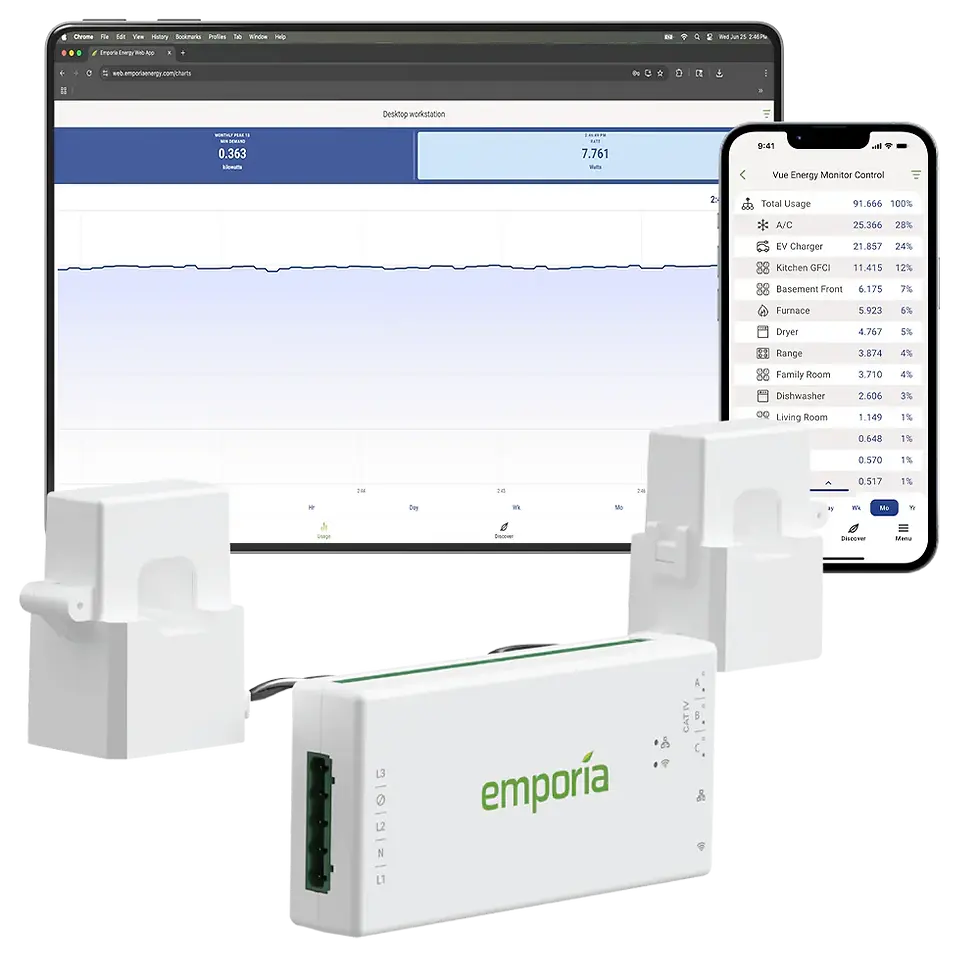
Then I got to thinking. My EVSE is on a dedicated circuit in my garage connected to its own Breaker Box. So I researched various power meter monitoring devices and settled on trying out a Emporia Vue 3 Power Monitor. I got it installed the weekend after Christmas and started collecting data from my charging sessions to make sure I installed it correctly and to see how the app and website works for data tracking and display. I am very impressed with the accuracy of the data coming from the Vue 3. The data tracking in the app and via the website are also very impressive and provides a ton of insight about what is happing during a preconditioning session (once I figured out how to get them to happen through the EVSE without charing happening at the same time). What is useful here is that I can track in real-time, the power going through the EVSE as well as get binned power averages for every minute. I can start one of my "experiments" and mostly ignore it until the experiment is over and then go look at the recorded data in the app or on the website.
SO, once I got the monitoring system up and running and I was confident in the accuracy of data that it was providing, I started to conduct some testing of Item #3 above by plugging in the car to the EVSE and manually turning on the HVAC via the Polestar App.... and.... Nothing. The app was showing the HVAC was running but "zero" power was running through the EVSE to the car. In my case, "zero" is about 6W of power. I have a ring camera plugged into the 120V outlet that is on this circuit and it pulls a tiny amount of power compared to the EVSE which pulls 100 to 1000 times that amount of power.

At this point, I figured that maybe I had something wrong with my Vue 3 setup and started to do some trouble shooting. This is when things got really interesting. I previously owned a 2021 Tesla Model Y and, as I said in the opening, I always assumed that a plugged in EV always, always, pulls power from the EVSE. I'll be honest, I just assumed this and never really thought to test this out with my Tesla. I found out that this is definitely NOT TRUE for a Polestar 3 (and I'll have to do some future testing with my daughter's Tesla Model 3 when she visits next).
I wanted to figure out what Polestar has said or published on this topic. There are two notable entries in the Polestar 3 User Manual. The section titled "Interior Climate when Parked" that seems to address this. In this section, you'll find the following statement:
For preconditioning to be available, the traction battery must be sufficiently charged. If preconditioning is started when your vehicle is not connected to an electrical outlet, the vehicle's range will be affected.
Elsewhere in the manual, there is a link to a video that states:
Scheduling the preconditioning to start while the car is charging keeps the precondition from reducing the battery energy and optimizes the range.
In my opinion, if the first statement is true, then the opposite of this statement is also true, i.e., when your vehicle IS CONNECTED to an electrical outlet (EVSE), the range WILL NOT be affected. This can only be true if the vehicle is pulling power through the EVSE while preconditioning, right? The second statement seems to indicate or further clarify that vehicle charging needs to be ongoing for preconditioning energy to come through the EVSE. My testing has basically verified that this is in fact true, but I wanted to discuss further my testing and some ways to ensure power is going through the EVSE during preconditioning.
So Polestar basically gave us the answer in the Manual above, sort of. If the vehicle is charging the battery while at the same, overlapping the time preconditioning is requested, the car will pull the max AMPS possible through the EVSE and share that power between preconditioning efforts and battery charging, but ONLY while BOTH are running. If Preconditioning starts BEFORE charging, the preconditioning will be from the battery until battery charging starts. If Preconditioning starts AFTER charging is over, preconditioning will be from the battery exclusively.
If battery charging stops while precondition is running, THIS is where things get interesting. One would think, based on previous rules, that precondition would continue, but only from the battery. Well, what happens next sort of depends on several things:
If Preconditioning was started Manually, and charging was started and stopped without a schedule, then Preconditioning will continue through the EVSE.
This is the ONLY manner to have Preconditioning without charging running through the EVSE and. the method I have been using to get Preconditioning data.
If BOTH were started with a scheduled event, the time relative to when schedules were set matter. I am not even sure how to fully explain what happens here without confusing everyone, but I'll try.
Between when charging stopped and when Charging was scheduled to stop, Preconditioning will continue from the battery, but in this case, if the SOC drops low enough, the battery will get a short burst of charge via the EVSE to bump it back up again. This will continue until the set Charging stop time is achieved and then the care will only pull energy for Preconditioning.... except. For reasons I cannot understand, I have seen in a couple of the tests, a short burst of energy through the EVSE, but not at max power levels but at levels consistent with what I would expect to see from the HVAC system (1-2 kW).
I believe what I have found is a flaw or a poor design decision by Polestar. In my opinion, if a car is plugged into an EVSE and preconditioning is turned on, manually or via a schedule, it should pull that power through the EVSE. Period, no questions asked.
With that said, I figured out a way to make that happen to be able to analyze #3 above. My process is as follows:
Make sure all schedules are turned off
Set the desired charge limit below the current vehicle SOC
Plug in the EVSE
Turn on Preconditioning (manually)
Change the charge limit to a value above the current vehicle SOC
Check Emporia to make sure power is flowing through the EVSE
Change the charge limit again to a value below the current vehicle SOC
Check Emporia again to make sure the power drops down from the max power level.
Monitor and record power levels for the next 30 minutes. Repeat if more time is needed.
Going forward for my morning commutes, I plan to use scheduled charging (smart charging so finish by time) and scheduled preconditioning each morning as follows to ensure 100% of the preconditioning is done from power that comes through the EVSE. I know for a fact that Preconditioning starts 32 minutes before the the desired temperature time, but more importantly, I know that smart battery charging usually finishes about 15-20 minutes before the desired time. This is likely because charging is not always highly predictable and Polestar has programmed in a little buffer to make sure that the desired charge level is achieved. Tesla had this same feature as well as it often finished 15 minutes or more before the desired time. I plan to set my desired smart charge time to be 30 minutes AFTER the preconditioning time, which will be a few minutes after when I roughly I leave for work every morning. This will ensure the vehicle has had at least 20 minutes every morning to precondition using wall power from the EVSE, and if I am delayed in departing, there is a little bit of margin on the back end for it to keep HVAC going before the vehicle stops charging. This means that the car might come up 2-3% short each day of the desired SOC.
Below is a quick sample of what I'll be discussing in my next blog. In all of my testing, I have seen big power pulls in the first 5-10 minutes of a preconditioning session before the power levels start to settle. There is often another power spike about 20 minutes after the preconditioning has started which isn't always as large as what is shown below. The final 10 minutes is typical of most sessions with a sort of sinusoidal behavior that hits a peak about every 3-5 minutes depending on the ambient temperature. More to come in the next blog once I get more data collected.

What an excellent writing, thanks for this! What I was missing from you blog was an analysis of breakdown of battery precondition and cabin preconditioning. So I made it myself: I have been struggling with getting information how to precondition HV battery with cabin preconditioning. Until yesterday and reading your blog I was in the impression that Polestar 3 does not provide HV battery preconditiong via GHCA charger but I was wrong. In northern Europe we have at the moment freezing cold weather (-15 to -20 Celsius ie. 5 to -5 F). And I had my Polestar 3 staying overnight outdoors so the whole car including HV battery pack is in similar temperature. I checked on the previous night that I…