
EV Chronicles #68 - Polestar's Winter Energy Usage Estimates ... SUCK

I have a 2025 Polestar 3 and have been running tons of winter tests the past two months. I just wanted to write this short rant.
The Polestar's navigation calculations for arrival SOC have generally been pretty good, often pessimistic, arriving with a couple percent more than the estimated at departure. But this winter, I have experienced a handful of instances where the estimates weren't just a little optimistic, they were downright horrible, double digit SOC horrible. I am not sure if this is completely Polestar's fault as their calculation may only be as good as what Google gives them, but it is also their choice to use Google Maps in the first place
I think I have discovered TWO significant issues with the Polestar Calculations:
WIND
PRECONDITIONING for DCFC charging stops
It seems that the Polestar 3 Navigation SW ignores both of these items completely in their calculations.
Case 1: DCFC Destination and Strong Headwinds
A few weeks ago, I drove 160 miles from home to a DCFC in temps around 22F into a fairly strong headwind (~15 mph). I started the day at 100% and the car was predicting about 22% on arrival at the DCFC 160 miles from my home. More than plenty buffer right!?
Side Rant:
For reasons I cannot understand, Polestar has decided to NOT give their owners any way to tell directly in the car or in the APP if the car is warming the battery in preparation for an upcoming DCFC. Even examples of EV with BAD SW like KIA/Hyundai show their driver's this information.
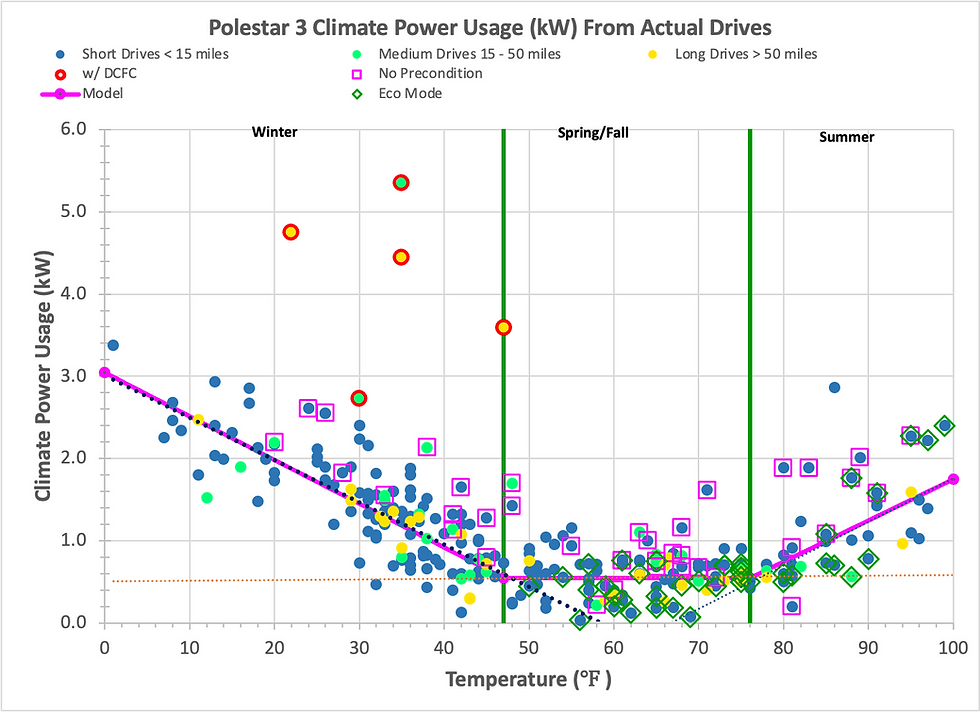
Thankfully, you can at least pull up the Trip/Energy App and if you are watch the power usage by the Battery/Electronics component closely, you can see if the rate of usage in this category of consumptions is now increasing at a faster rate once battery conditioning has started.
On this drive, I wasn't watching Tip/Energy App like a hawk, but I noticed my vehicle started to pull much higher amounts of energy about an hour before I arrived (about 1.5 hours into the drive). Up to this point in the drive, the estimated arrival SOC had already started to drop slightly. I actually don't recall all the exact numbers because this was the first time I had actually experienced this in my vehicle. It was my first winter drive with a DCFC charging stop entered into the navigation. I think after the first 90 minutes or so, I had already lost about 6% of my buffer... so now estimating roughly 16% SOC arrival, but one would still think I had plenty of buffer remaining.
Then, one hour before the DCFC stop, and my estimated arrival SOC starts dropping rapidly. I was losing about 1% of charge every 5 minutes or so. I had one bailout option about 30 miles before my destination and I almost pulled the trigger an pulled off, but I decided to keep going. I ended up having to slow down a bit in the last 15 minutes to keep my estimated arrival SOC from dropping below 5%.
I arrived with 5% SOC and the vehicle indicated it pulled 6.3 kWh of energy for the Battery. Based on what I know right now, I believe that I lost about 6% of my arrival SOC to the preconditioning of the battery and another 12% to the system not factoring into the equation, the impact of the prevailing winds that morning. Issues I never had with my 2021 Model Y (at some point during ownership, one of the SW updates from Tesla included accuracy improvement for the losses due to wind, but they were already pretty good).
Case 2: Round-trip with strong winds and one DCFC Stop
Today, driving in temps near 12F, similar highway driving, we did a round trip on the same highway as the above trip was taken, just not as far today and we did a round trip, so the impact of the wind was definitely noticeable. We had crazy winds today in the 20-25 mph range all day. By my estimates, for a 96 mile one way trip, we used 11% MORE going west INTO the winds than we did on the return drive. I was looking at about 6% SOC at arrival at home and wasn't 100% comfortable with that (with my wife in the car anyway, would have done this solo no issues), so about 20 miles out from a DCFC, I added a charging stop to the navigation. I knew this was actually a possibility when we left our starting point so I actually had already added the Sheetz where the Tesla chargers were as our destination but not the chargers there. Our estimated arrival at the Sheetz held solid the entire trip and then after I switched my destination to the chargers, I lost 2% for my SOC arrival slowly in those 20 minutes. Not immediately, but slowly.
Side Note: 20 minutes was not enough time to properly condition the battery in these temperatures. I didn't expect it to be honestly. I pulled only 85-95 kw of power in 4 minutes where I added about 5%. Tesla charged me for 6.8 kWh of Energy, but I believe only about 5 kWh, maybe 6 kWh actually got into the battery, the other 1-1.8 or so was probably going to keeping us warm (it was 12F) and still trying to warm up the battery. I hope to try another similar experiment by set the destination about 40 minutes before the DCFC arrival and see I get closer to optimal results. I believe this is another area where the Polestar SW isn't great and it might be using TOO much energy to precondition when a DCFC is in the Navigation more than 90 minutes before arrival. I have no idea if I am right about this but hope to test this out soon!
Key Takeaways:
Polestar's winter weather consumptions calculations IGNORE two critical and very important items that have significant impact to a driver's estimated arrival SOC at any destination.
When adding a DCFC as your next destination in winter temperatures, it is a good idea to add an extra 5-10% above and beyond the normal buffer one my plan for a long trip
Polestar 3 Drivers really need to pay close attention to the wind conditions expected on a drive. I never had to do this in my Tesla and have now learned this lesson. I don't have a steadfast rule of law here yet. In case 1, I lost about 10% of my buffer over 160 miles of driving. Case 2, I lost 11% over 96 miles. For now, I am personally going to always add 1% of buffer for every 10 to 20 miles of driving I have to do when I am driving INTO the wind, depending on the speed of the winds. Here is what I am going to use for now for every 100 miles of driving INTO the wind:
10-15 mph then I'll use about 5% extra
20-25+ mph then I'll use about 10% extra
I am going to use: https://www.windfinder.com/#8/28.4542/-81.3043/spot when planning any trip over ~150 miles from now on. They have an APP too.

Screenshot from Windfinder.com website (map of central Florida)
Comments