
EV Chronicles #69 - EV Winter Energy Usage Analysis

This is a long one, so buckle up fellow EV nerds. If you own an EV, you have most likely been asked this question, probably many, many times:
"How much Range does your EV lose in the winter?"
So, if you are just curious or your yourself are considering buying an EV in the future, you have come to the right place! I hope to enlighten you with this blog to expand your basic understanding of thermodynamics and how to apply that knowledge to understand how EVs work in winter weather!
If you are an EV owner and specifically a Polestar 3 owner, then I have a treat for you below with some very scientific data and analysis that is from experiments I have conducted with my 2025 Polestar 3. If I end up getting too deep into the weeds here, don't blame me! YOU actually clicked on a link somewhere, willingly I might add, to subject yourself to my "nerd level 3000" ramblings about EV Winter Energy usage. But at least I'll do you all a favor an give you the BLUF now.
Bottom
Line
Up
Front
Since mid December 2025, we have been having some VERY COLD weather in our region of the country (SE PA). Unseasonably COLD in fact. Sucks for those of us that have to live with this cold daily, but it has provided the perfect backdrop for conducting a few interesting cold weather experiments and data collection. It has given me an opportunity to to measure and record the energy my vehicle uses to warm up in various ambient temperatures. It has given me many opportunities to record the energy used by my vehicle as reported by the trip computer for over 70 different drives, most of them from my ~11 mile one way commutes, in temperatures ranging from 1F to 57F. It has given me an opportunity to monitor the amount of energy that my Polestar 3 uses to precondition the battery to prepare for a DCFC charging session on 4 occasions (more data needed here).
Here is the recent history of the local weather about 10 miles from my home location (nearest weather station to my home) in the Weather Underground database:
Real World Efficiency, Real World Impact to EV Drivers
For each and every drive I have recorded this winter, I have been able to leverage the Polestar 3 Infotainment system Range/Energy App that reports to the driver, the energy for each drive the amount of energy utilized by Driving, Climate, and Battery/Electronics. I have discovered that no matter what, the Polestar 3 utilizes about 600W of power no mattery what, on every drive. I assume this is to run components like the computer, the lights, the sound system, the cellular connection, and such. So for this analysis, I have decided that I should remove the base 600W of power (converted to energy for time of the drive) from this data from the Battery/Electronics category to get a true comparison of the impact of weather.
The method here: I computed the % Increase in the energy consumption with HVAC and Computer/Electronics as compared to just Driving Energy without those components. I then figured out an equation to take that value and convert it into a Range Loss as a percentage. I am not 100% sure that this is the best way to show this data but it is what I have decided to do. This means for example that any drive that had a 20% increased energy consumption, that for every 10 kWh of energy that was needed for driving, that 2 kWh of additional energy were used up BECAUSE of weather. But because of the mathematics, range loss is computed by dividing total pack energy by consumption energy, So, for 20% increased energy consumption on a drive, the actual Range Lost would be about 17%. I feel that most people want to know about the Range Loss, and not the increase in energy usage.

Key Observations from this Data:
Although there is a clear trend in the data that Range Loss generally increases as temperatures drop, you cannot determine an exact range loss value just from temperature. You can get a statistical prediction or average from the data and a possible max and min value you could expect at a given temperature
I generally consider Range Loss below 5% to be "in the noise", so I would say that noticeable range loss generally starts somewhere below about 40-50F. Most drivers on most days wouldn't even miss the additional energy consumption unless they were embarking on a really long drive (in excess of 150 miles).
The longest drives (yellow dots) and medium range drives (green dots) are generally at the average or below. This likely proves out that even with my 20-30 minute warmups for my shorter drives (commutes), that there is still extra energy being pulled to warm up the car on drive.
The exception to this observation happens for drives that have a planned DCFC charging stop at the end of the drive, pushing up energy consumption significantly
Not preconditioning the vehicle generally resulted in above average energy consumption for the drive and larger range losses.
On an average work day, I use 8% of my battery on my commutes in ideal, mild weather conditions. In the winter, I have used as much as 10-12% in a single day. Because I have home charging, it just doesn't matter for me. I just go home and plug in and start the whole process all over tomorrow. ~75% of my recorded drives were less than 15 miles of driving (every blue dot in the graphic above), making the extra energy consumption/range loss basically irrelevant. Of these drives that were over 15 miles, most of those had less than 10% range loss for the drive. Of the drives with more than 10% efficiency loss:
4 of them were drives that had the battery conditioning overhead needed for the DCFC charging stop at the end of that drive
3 occurred because I wasn't able to precondition the cabin before getting in and driving, resulting in significantly more energy being pulled from the battery to bring the car up to temperature DURING the drive
2 occurred because it was F'ing COLD - 16F and 11F
Both of those were drive less than 50 miles, so the additional energy usage would have been noticed, but I wasn't driving far enough that day for this to actually impacte my driving and charging experience that day
Nerd Level Analysis Starts Here
I would like to start this analysis by pointing out that gas vehicles also lose "range" in the winter. In fact, they might actually have worse range loss in the winter than most EVs depending on the conditions under which they and comparable EVs are being warmed up and driven. Did you know?
Cold (gas) Engines consume significantly more fuel than warm, properly heated engines. Short-trip driving in the winter can reduce fuel economy by 10-25% (lower temps = less efficient)
Full disclosure, I don't know what is considered a "cold engine" in this statement and how long it takes for an engine to be considered "properly heated". I am guessing at least a 5-10 minute period, but likely longer. Extremely relevant for quick, short drives, but maybe not as relevant for long drives.
Hybrid vehicles often suffer even more economy losses in cold weather than many standard gas engine. By up to 35% reduced fuel economy
Prewarming a gas car results in range loss (energy burning while no miles being driven) that almost NO ONE every talks about
Idling 15 minutes of an average gas engine, burns about 0.1 gallons of fuel, which is 2-4 miles of range lost. If you have a 10 mile commute, you just lost 20% or more of your range.
I would also like to point out that in the past 100+ years, almost no one has ever raised a concern about the range lost in the winter by a gas powered vehicle. So I ask you, why all of a sudden that EVs are the new kid on the block, are we seeing this question being asked constantly? Is it just ignorance? Ignorance of the fact that GAS vehicles lose just as much range as EVs in the winter? Or is there something else going on here?
Let's break down all the places where an EV potentially loses energy and how those loses may impact the range of the EV in the winter and discuss the testing and analysis I have conducted this winter on my Polestar 3.
Heat Transfer 101
The First Law of Thermodynamics is that energy cannot be created or destroyed, but it can be converted. In the case of all vehicles, standing still OR moving, the amount of energy that the vehicle loses into the atmosphere as a result of the temperature differential between the interior and exterior must be replaced by adding the same amount of energy into the vehicle. Otherwise the cabin would not hold its desired temperature. A gas vehicle creates this energy by burning fuel to release thermal energy and a battery electric vehicle uses a chemical reaction in the batteries to turn chemical energy into thermal energy via a heat pump or resistive heating.
I am not about to bore you with 6+ credits worth of college level course work in Heat Transfer and Fluid Dynamics. The differential equations that I have long forgotten can be used to model very complex systems to a very high fidelity. Thankfully, these equations can also be simplified significantly by applying some assumptions such as uniform temperatures of objects, uniform fluid flow, and objects at steady state temperatures. At the most basic level, heat transfer (thermal energy transferred) over small temperature differences (10's of degrees C) between two objects is simply a linear function of the temperature differential between those objects at any instant in time.
In the case of any moving vehicle. The energy needed to keep the cabin at 68F when the outside temperature is 8F (60F differential) would be roughly double the energy needed if the outside temperature is 38F (30F differential), and this linear behavior can be clearly seen in the data I have collected that I'll discuss below from my many commutes this winter.
I have also conducted many experiments of my vehicle sitting still in my driveway at various temperatures while I attempted to measure the energy the HVAC consumed at steady state. For reasons that I don't fully understand, when a vehicle is sitting still, this linear behavior was more difficult to observe. I am guessing that in these cases, there are factors that are playing a more important role in the system when I have conducted experiments of my car just sitting in my driveway. Namely, I think that the amount of sunlight and any slight breeze cannot be ignored and thus the data collected for an EV standing still has a much larger standard deviation for those experiments.
At this point, let's dive deeper into energy drains in winter driving:
Preconditioning the cabin (and battery) before Driving
HVAC to hold cabin temperatures during driving
Energy for Heated Seats and Heated Steering Wheel
Battery Conditioning for DCFC Charging Stops
Preconditioning before Driving
It takes a great deal of energy to raise the temperature of the air and the internal surfaces and materials on the inside of ANY cold vehicle. That energy has to come from somewhere. In a gas vehicle, that energy comes from burning gas to run the engine and then using the excess wasted heat energy that is produced to warm up the vehicle. In an EV, that energy has to either come from the battery or from the wall through the EVSE when plugged in.

I actually already wrote a little bit about this in Blog #66 where I talk about how much energy my vehicle pulls through the wall charger while Preconditioning the cabin (and I assume it is also warming the battery to be able to deliver power for acceleration and receive power from regenerative braking). In that blog, I mentioned that neither my Tesla Wall Charger (EVSE) nor my Polestar 3 Apps provides the owner with any sort of detailed power usage that would be helpful to understand how my Polestar 3 pulls energy "from the wall". For this reason, I have installed an Emporia Vue 3 Power Monitor into the Breaker Box in my garage to be able to collect high fidelity energy usage data for my experiments.

To the right, you can see a single example of a preconditioning session that I recorded over the holidays (I didn't record the ambient temperature). This warmup session was typical of almost every charging session that I have recorded the past two months. The Polestar 3 will run climate controls for 45 minutes before shutting down when manually starting the climate control via the Polestar App. As such, I recorded data generally over a 40-45 minute period for these experiments. A typical warm up session for a Polestar 3 (and likely the same for many other EVs) has the following characteristics:
Huge Initial Energy Usage in the first 5 Minutes
In these first 5 minutes, the energy usage was nearly at the limit of the EVSE.
This was was about ~25% of the total Energy pulled from the wall over a 45 minute warmup test.
Energy Usage Ramp Down
Minutes 5 to 20, the energy usage would generally ramp down from the max usage levels at the beginning to nearly steady state energy usage levels.
Speed of this ramp down to steady state was somewhat dependent on the ambient temperatures of the car before this test started
Steady State Energy Usage
After 15 to 25 minutes, the Polestar 3 generally achieved steady state conditions and used about 1-2 kW of energy steady state.
The power usage was basically a sinusoidal curve that varied between about 1 to 2 kW of energy indicating that the HVAC was cycling between modes or levels.
What I found very interesting here is that the energy usage at steady state levels while plugged into my wall were only slightly correlated to the ambient temperatures. In extreme cold, I could see more energy usage happening, but as ambient temperatures exceeded 30F, the correlation was tough to see through the data collected.
Unexplained Spikes in Energy usage ~30 minutes after start
For reasons I don't yet understand, my Polestar 3 sometime requests a short burst (~2 min) of energy which can be nearly double the steady state power usage levels. This can be seen in both sets of data (above and below)

To the right is the data from one warmup session of the Polestar 3 at 15F. I took the data from Emporia and entered it into Excel. The Blue Line represents the average power (kW) being pulled through the EVSE over each 1 minute period (similar as the Emporia data above but in line graph form from Excel). Here you can see a huge energy pull occurring in the first 10-15 minutes, followed by a period of time where the power usage slowly reduces further but doesn't quite achieve steady state energy utilization until the end of the test. In other tests I have conducted (at warmer temperatures), steady state is often achieved 20-25 minutes into the warmup session.
The Orange Line represents the cumulative energy utilized since the start of this warmup session (in kWh - secondary Y-axis on the right). This data indicates that Polestar 3 owners (and likely true of many EVs) should try to warmup their vehicles for at least 15-20 minutes before disconnecting from "shore power" to minimize range loss due to this initial energy draw. For me personally, I almost always get 25-30 minutes of warmup each morning before I start my commute.
Unfortunately, when the vehicle is preparing for my trip home, it doesn't have access to any wall power. Thankfully, it is often warmer in the afternoon so a bit less energy should be needed for the trip home. I often lose about 1% during the day of phantom drain and another 1-2% for cabin conditioning before I get into the vehicle. I set the Cabin to be warmed up by 4pm, which means that it starts conditioning at 3:28 PM (always 32 minutes before). This means that I generally get about 20-30 minutes of warmup before heading home, all completely from my battery. Based on my data, I am using roughly 1-2 kWh of energy each day before leaving work. For a Polestar 3, for simplicity sake, let's assume 100 kWh of usable battery (actually closer to 110 kWh) and that in ideal conditions, 1% of battery = 1 kWh = ~3 miles of driving. So for a typical warmup session, I am losing as much as 3 to 6 miles of range to drive 11 miles. On this one leg by itself, I just lost 21-35% of my driving range. If you consider the entire day of driving, this would equate to a loss of 12-21% of my driving range. This sounds bad, but this is also because my commute isn't very long. If my commute was 20 miles for example, my total effective range loss for the day would only be 7-13%. This is computed by taking total miles driven and dividing by total miles driven plus miles lost due to conditioning (40/(40+6) = 87% or 13% lost).
As I mentioned above about in the 101 section, I tried to conduct dozens of experiments while my car sat in my driveway to determine if I could trend the amount of energy that my Polestar 3 needs to maintain cabin temperatures as a function of ambient temperature. Unfortunately, this data was "noisy" with huge deviations and didn't provide a great dataset or trend to talk about here. The truth of the matter is that EV drivers need to understand that an EV uses a fairly large amount of energy to warm up the vehicle, and if possible, try to do this while the vehicle can pull energy from the grid, not your battery.
Now that the up front warmup tax is out of the way (and hopefully for most, this is a non-issue as many EV owners can pull the energy from the wall and not their battery), let's talk about the physics of energy consumption while driving. So that leaves THREE primary functions that most EV owners need to be worried about which consumes battery energy, thus resulting in lost range in cold weather driving:
Using the HVAC system for cabin climate
Using the heated seats and steering wheel heating for additional passenger comfort
Battery conditioning (warming) to ensure the battery chemistry is at the right temperature upon arrival at a DC Fast Charger to achieve optimal charging performance on longer road trips.
HVAC Energy for Cabin Climate
I have already stated this, but just to reiterate, what is important here in the physics here is that the rate that energy that moves from the EV battery to the cabin and the cabin to the ambient air (lost energy) is determined by the temperature differential between the interior and exterior temperatures. There are of course, other secondary factors at play as well that contribute to the system and rate of energy loss. Things like vehicle speed, wind velocity, humidity, precipitation and even sunlight conditions (time of day and cloudiness) just to name a few. The duration of my warm-ups before each drive could also play a role in the variability of the data as some drives might have occurred before my vehicle truly achieved steady state conditions (although I tried to only include data from drives where I had a least 20 minutes of warmup).
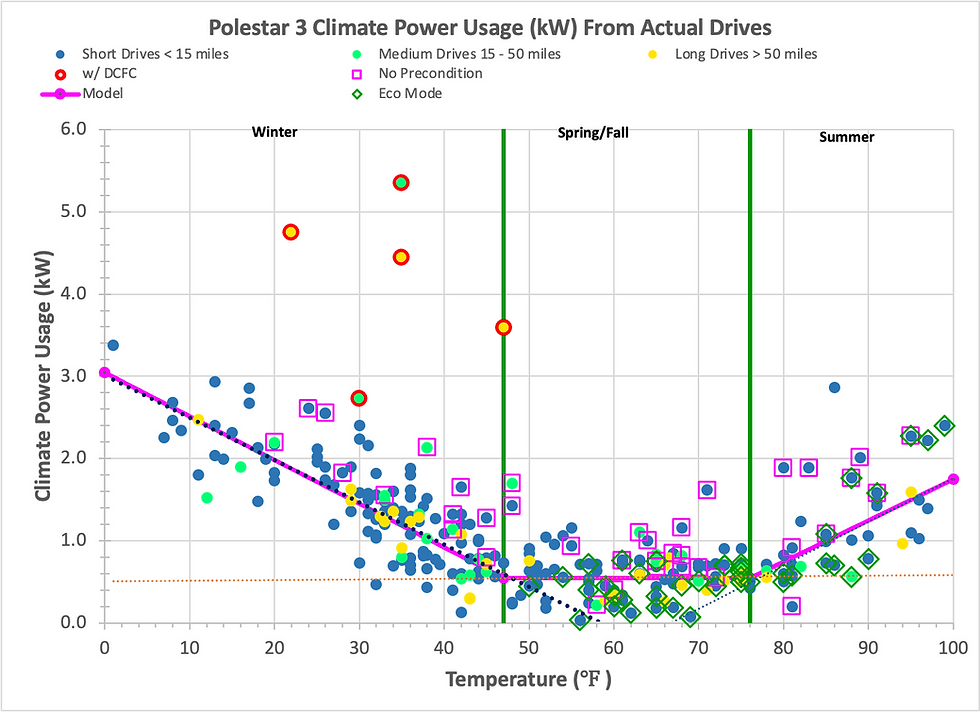
The figure directly below shows the data that I have collected so for from over 70 different drives, mostly on my daily commutes to and from work. This data removes 0.6 kW of energy from the data as it has been determined that in its current configuration, my Polestar 3 draws approximately this amount of energy no matter what the temperature happens to be. I presume this is for running things like the Infotainment computer, drive system computers, radio, lights and other overhead electronics that require constant power.
Also note that the data below for all drives under 50F, I have set the driver's seat set to Level 1 heat and the steering wheel set to Level 2. This is about 100W of total power and is generally in the noise of the data below (more on heated items in the next section below).

My key findings from this data that is specific to the Polestar 3, but can likely be extrapolated to most EVs (for example the slope of the trend line maybe be slightly different for other EVs):
They data clearly shows that the temperature differential is the dominate driving force here
It looks like increasing winter weather energy consumption starts to be noticeable starting at about 45F and below
I need much more weather testing in the 40-60F temperature range to get a better understanding of where the HVAC power starts to truly increase
Above ~45F, the Polestar 3 appears to ALWAYS uses roughly 200W-500W of energy just as a base for battery thermal management and base HVAC.
I need more data but have to wait for mother nature for it to get warmer here.
This is a tiny amount of energy in comparison to the overall energy consumption in an EV.
In EXTREMELY cold temperatures (near 0F), the Polestar is using 2.5 to 3 kW of energy above the minimum baseline to keep us warm and comfortable.
Takeaway: STOP making you and your passengers uncomfortable by turning the HVAC way down or OFF in the winter. The science and data just doesn't support that enough energy is going to be saved here by doing this. You have to assume that the physics works in either direction here. The data is showing that the energy usage increases linearly as outside temperature drops and the interior temperature is held at about 68F (plus or minus a degree or two). The differential is the key here so one could assume that dropping the temperature INSIDE (reducing the differential) will have a similar impact on the HVAC energy consumption. You would have to drop the interior temperature by 20 degrees to reduce the HVAC energy consumption by 1 kW in my Polestar 3. For every hour, that means in a Polestar 3, freezing inside the car to "save energy" only saves you about 1 kWh of energy or roughly 1% of its battery. On a typical road trip, I am stopping every 2 to 3 hours, and thus consuming only an extra 2-3% of the battery between stops to stay warm. Adding that extra 2-3% to the vehicle at every DCFC stop costs the owner about $1-1.50 and adds maybe 2 minutes at most to each charging stop.
Heated Seats and Heated Steering Wheel
You will often hear from EV "experts" that the most efficient to stay warm in the winter in and EV is to use the heated seats (if your vehicle has them - hint, don't buy an EV if it doesn't have them), because the heated seats use less energy than the HVAC system. I have been unable to find any Polestar documentation online about how much energy their heated seats and a heated steering wheel actually uses. A quick Google search indicates that an average EV heated seat consumes 30-60W per seat nominally with a maximum of about 120W when on the high setting.
While plugged into my wall charger, I was able to command the front and rear seats on and off as well as the heated steering wheel on and off all from my Polestar App. Because the HVAC has to be running to be able to control these components, and the HVAC energy draw fluctuates a bit, it was difficult to get a very precise energy consumption number, but I was able to get some rough numbers from my observations. My Polestar 3 measurement are actually consistent with what the internet states.
| Power Consumption per Power Level (W) | ||
Power Level -> | 1 | 2 | 3 |
Front Seat | 30 | 65 | 125 |
Rear Seat | 25 | 50 | 100 |
Steering Wheel | 40 | 75 | 150 |
Highlight above indicates my preferred nominal settings in winter driving.
Takeaway: the amount of energy utilized by heated seats and steering wheel is only a fraction of what is used by the HVAC. Owners should never think twice about turning them on if they enjoy them. The power lost is "in the noise" to be honest. For us, my wife can experience motion sickness at times, and as such, she prefers the cabin to be a bit cooler than I like. Even though we can set different temperatures on each side of the car to our preference, I find that leaving my side a bit closer to her desired temperature and then bumping up my heated seat a level makes both of us very comfortable.
Battery Preconditioning for Next DCFC Charging Stop
The final significant source of energy loss in non-Summer driving is really only applicable to those of us that enjoy taking our EVs on road trips or rely on DCFCs for daily charging. For those that are not aware, most EVs have a feature where the vehicle will heat (or cool in extreme heat) the battery to achieve an optimal temperature range in order for the next DCFC session to achieve maximum charging speeds. Batteries do not like to be charged at high rates when hot (see Blog #60 for our hot weather charging woes) or cold.
So far this winter, I have only recorded energy usage from 4 drives where the destination in the route planner was a DCFC station. This is the ONLY way to force a Polestar 3 to precondition the battery for optimal charging sessions. I have to admit, the results are a bit confusing so far but I have some theories about what is happening.
The range of energy needed for each of these 4 preconditions was roughly 1, 2.5, 3.7 and 6.5 kWh.
The drive that resulted in the LOWEST amount of energy happened on the second leg of a long trip, after one (cold) DCFC session was executed. I believe the battery warmed up significantly during the first charging session and that carried over in such a manner that not much additional warming was required for the second (and final) charge on that day. The HIGHEST amount of energy happened from the coldest temperature (22F) and longest (nearly 2.5 hours) drive of the group, after the vehicle sat all night in temps around 15-20F. I noticed on this drive that it looked like the vehicle started to increase its energy usage significantly about 1 hour before arrival at the DCFC. Unfortunately, Polestar doesn't give the driver any other indicator that it is actually preconditioning the battery.
The other two drives are interesting because the higher energy usage for preconditioning drive of the two was at a temperature that was 12 degrees warmer than the other one, but it was a longer drive (time and miles) by almost double (45 minutes vs 100 minutes). This suggests that preconditioning, at least in a Polestar, might not be completely optimized, or maybe 45 minutes just wasn't long enough to complete the preconditioning cycle of the car. But here is the thing, I don't recall that charging session being degraded or slower than any sessions where the vehicle had more than an hour to prepare for the charging session. This suggests that Polestar might not have a well tuned approach to preconditioning? Over time, I'll have to do some additional experiments where I might set the destination as a POI right next to the chargers and just drive, and then 30, 45, 60 minutes or more from the charger, change the destination to the charger to get it to start conditioning. I am thinking it might take years to test this out because I don't have time to execute an experiment that I am thinking about for doing this. (Update I tried this once with 20 minutes of preconditioning and only achieved 85-95 kW at 15% SOC - 190 kW is nominal at this SOC)
I discussed the de-rated charging sessions I saw this summer in extreme heat on our way to Florida in Blog #60. On that trip, I experienced charging rates that were 30-50% lower than the theoretical maximum I have experienced in ideal weather conditions, an experiment I'll have to do again this summer when we get extreme heat again (as I sit here anticipating the COLDEST weather of the season with wind chills of nearly -20F this weekend).
I recently left my Polestar 3 sit for an entire weekend in temps well below 30F and then had to DCFC it immediately before getting on the road. At 15% SOC, I was ONLY pulling a sluggish 50 kW of power when the theoretically maximum charging rate at that SOC is close to 195 kW. Considering I typically add about 60-75% at each charging stop, that would be 75 to 90 minutes of charging at those rates! YIKES! That charging session was brutal, but it was the perfect example of why spending energy to warm up a EVs battery in cold conditions is typically desired.
In these tests, the energy pulled from the battery for preconditioning was mostly unnoticeable for all of these drives using 2-4% of the battery in most cases. The one drive that used a ton of energy WAS noticeable, particularly during the last hour of the drive as the estimated SOC at arrival dropped from the mid-teens into the single digits. I ended up arriving at 5% SOC. Despite the additional energy needed for each segment of a long trip, most EV owners will agree that spending a little extra money for the extra energy is worth it to save yourself hours of extra charging time on a long day of driving.
So, I just threw a ton of information and data at all of you. My intent was to give you all a ton of data that demonstrates that when you look at each of the individual components, and even if you add them up as done in the BLUF data, the actual loss of range, or actual miles you can drive vs. the ideal maximum miles you could drive in mild weather, just isn't nearly as bad as "the internet" wants non-EV owners to believe. And when it does matter, it actually happens so infrequently that it just doesn't really matter to most EV owners.

Comments