
EV Chronicles #72 - Polestar 3 HVAC Energy Usage

In a post back in February, I explored what I knew after 2 months of winter driving data collection to give an early assessment and analysis of how much energy my Polestar 3 used for for HVAC functions. You can find that post HERE. At that time, I only had a couple of months worth of data and had almost no data in mild (what I call Spring in my data) and zero data in hot weather. It is now mid-July 2026 and I have now collected data on roughly 270 different drives, with 40 above 76F which is what I consider the lower bound of Summer Driving.
The Methodology
I mentioned the methodology in my previous blog post, but to reiterate, the Polestar has an efficiency app that records the sources of energy usage for 3 counters. Current drive, since last charge, and since last reset. I primarily used the Current Drive counter to record the data from my drives. At the end of each drive, I get six parameters that I used in my calculations to generate the data below.
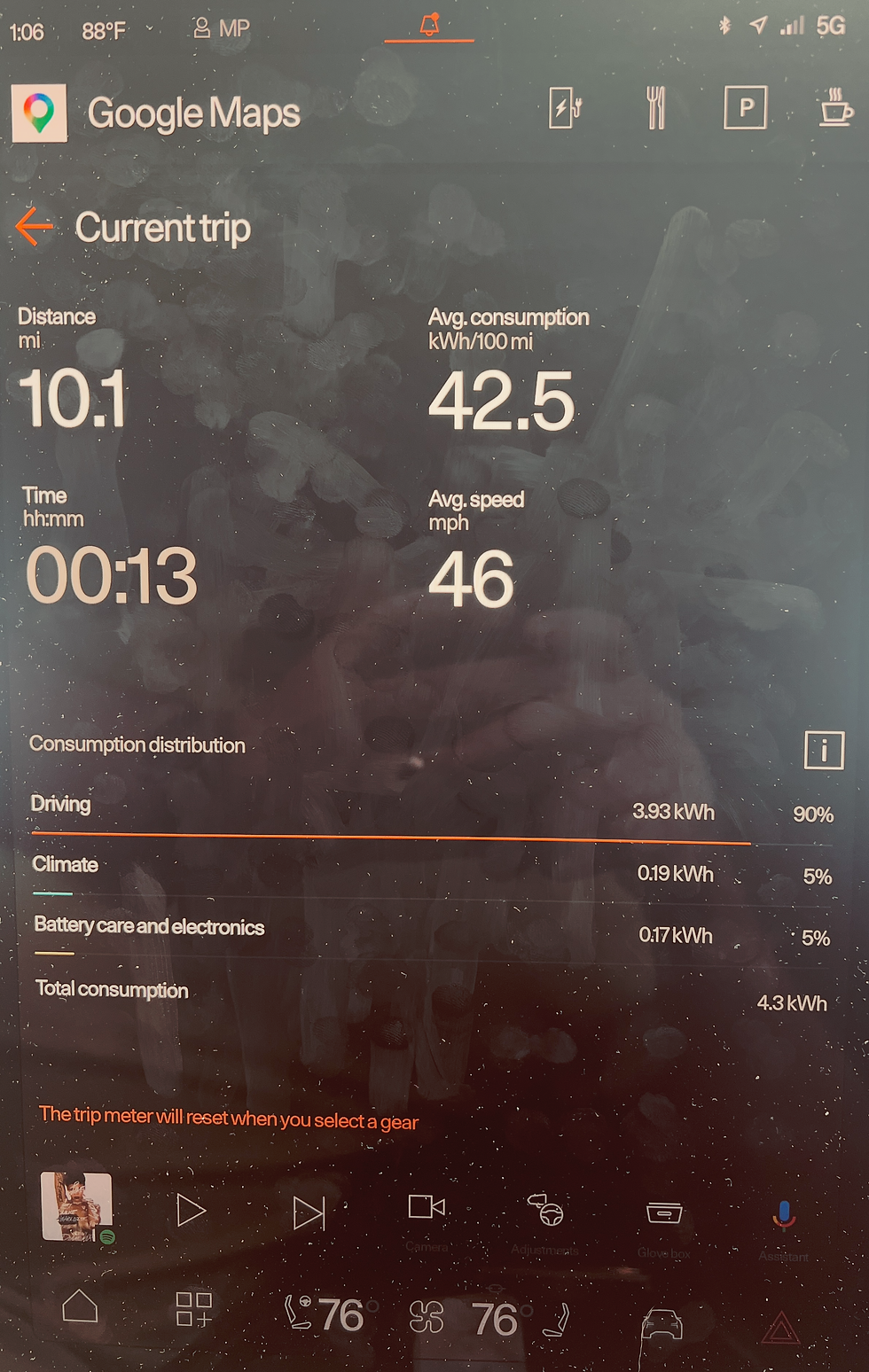
The data above includes:
Distance Driven
Time (driving time)
Average Speed
Energy Consumption rate (kWh/100 miles) - I don't love this number because it lumps in the impact of driving speed, HVAC, and battery/electronics energy.
Energy used in driving - Primarily driven by speed and altitude changes, secondary impacts due to weather (wind and precipitation primarily, air density as a function of temperature has a minimal impact)
Climate Energy - I primarily use this number / Drive Time to get HVAC average power during the drive
Battery and Electronics - I have discovered that a Polestar 3 uses 600W of power no matter what the weather conditions currently are (lights, radio, computers). As such, I have removed this 600W before using this number in the rest of my calculations. Whatever is left I assume is needed because of factors that are being driven by the current weather and include it in my energy consuption analysis.
This component is rarely much of a factor except when a DCFC is selected as your NEXT destination, in which case, it really has a big impact on your energy consumption. I have written about this one of my winter weather posts. Unfortunately, Polestar seems to completely ignore this aspect of weather energy usage when estimating your SOC at your next destination. So, on winter trips where many DCFC stops are planned, you should add and EXTRA 5-10% above your computed arrival SOC at the next charger.
The Data Analysis
Let's start by giving you my BLUF (Bottom Line Up Front). A summary of the data findings and my observations:
Pre-Heating/Cooling your vehicle (hopefully while charging) right before you start your drive significantly reduces the energy that is used for HVAC functions During your drive, particularly short to medium range (time) drives.
Overcoming the initial temperature (really cold or really hot) to achieve a comfortable temperature in an EV doesn't take long, but it does use a significant amount of energy...as much as 2-3 kwh in some situations. If you can pull that energy from the wall instead of your battery, then you won't experience much range loss due to HVAC usage.
There is a huge temperature range between 40 and 80F where HVAC energy is basically a non-factor. My Polestar 3 used about 0.5-1 kw of continuous energy in this Temperature range.
Using ECO mode DOES save energy in the Summer
For the many drives where I used ECO drive, the energy used was typically below the mathematical fit of the overall data.
There is an impact though, particularly on a very hot and humid day. The strength of the AC is definitely dialed back in ECO mode. In humid weather in particular, you can really tell that one of the compromises in ECO mode is that the humidity doesn't get reduces as well as when the HVAC is set in a normal setting.
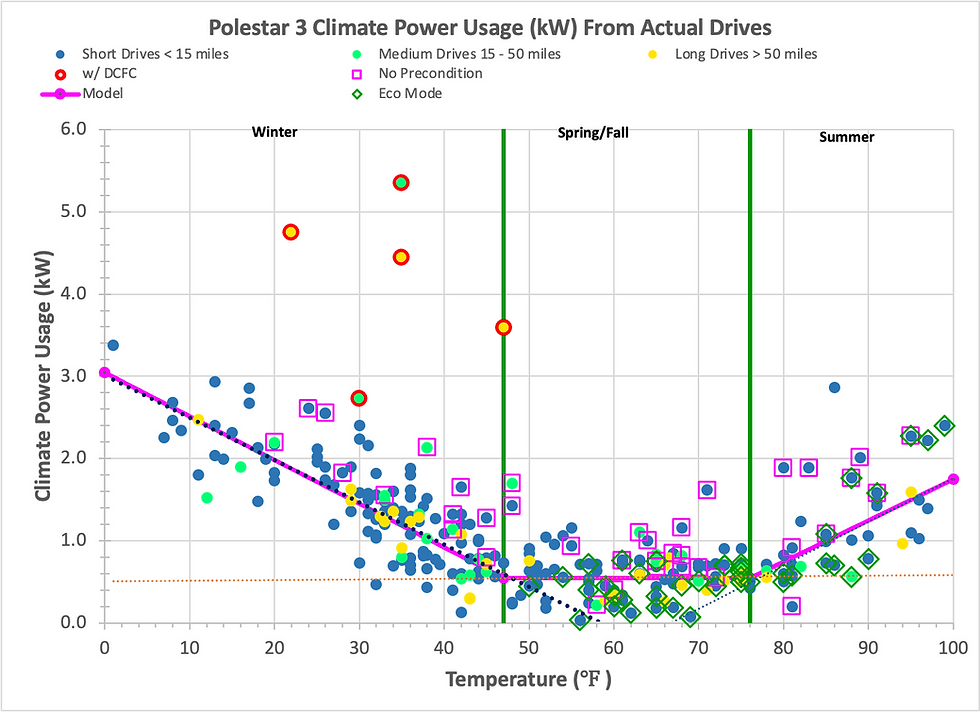
HVAC energy usage is dominated by ambiant temperature, but there are many other factors that actually result in a wide range of energy usage at a given temperature in my testing. My detailed analysis and finding a mathematical best fit of the data shows at every temperature, there is roughly a +/- 0.5 kw error (2 Sigma) from the linear curve fit. The other factors include:
Preconditioned cabin or not (clear to see the pink square data sets below are generally well above the average line)
Setting a DCFC as a destination, which results in significant amounts of energy used to get the battery to optimal charging temperatures (mostly in the winter and spring - huge energy impacts))
ECO Mode (data below in Spring and Summer conditions shows these drives generally below the line fit)
Other misc weather conditions like sunny vs. cloudy, humid vs dry.
Cold Temperatures do NOT use significantly more energy than HOT temperatures for every degree of F outside of the middle range. People talk about Cold temperatures, because many regions of North American CAN experience 40-60F BELOW the middle range of temperatures (temps of 5F to -15F), but it is nearly impossible for most of North American to experience much more than about 25F above this middle range (100F)
They also talk about range loss in cold weather because of the additional energy utilized to precondition the battery on route to a DCFC charging location in cold weather. I have not yet experienced (at least not recorded the data) for a DCFC stop in warm weather and suspect that the battery temperatures don't need to be manipulated much in warm weather prior to a DCFC charge.
Figure 1: Plot of Polestar 3 Climate Power Usage
Additional Observables from the Data:
The Polestar3 uses about 600W of Power in ideal conditions (100-1100W from the data)
The increase in energy usage per change in degree F is about the same in cold weather as it is in hot weather.
Longer drives (yellow dots = over 50 miles) results in much less disparity of the data relative to the curve fit lines.
The theory is that for all of my shorter drives, there might be situations where the vehicle hasn't fully preconditioned yet, and as such, there is some early peak energy usage happening where the cabin temp is still normalizing.
The biggest takeaway for me is that the energy used by the HVAC is basically unnoticeable or "in the noise" in relation to the other sources of error when the computer is trying to estimate the SOC at your next destination in the navigation. Fo roughly 90% of my drives (in my particular region of the US) temperatures fall between 35F and 90F, my Polestar 3 uses no more than 1.5 kw of energy. At highway speeds, the Polestar 3 could go for about 3-4 hours before needing to stop for a charge. That equates to a total of at most 6 kwh of energy or about 5-6% of the battery for that drive. For me personally, I cannot go that long before needing to stop. On a long drive, I go about 2 hours at most so I am only missing about 3% at most under most weather conditions on my longest drives. For those with bladders of steel, this could cost you about 10-20 miles of range out of roughly 270 miles at highway speeds. Most people would never even notice this additional drain to be completely honest.
The ballgame completely changes though as soon as you add a DCFC charging stop in cold weather. The lost energy starts to really feel real and definitely needs to be planned for and taken into consideration. I have not recorded any DCFC drives in Summer weather yet, but I suspect that nearly zero energy is needed for this unless temperatures are extremely hot or the vehicle has been working hard (climbing or towing).
I didn't have all of the same detailed data from the Tesla that I owned but I collected similar data and experienced a similar bathtub data set. I believe that most EVs with a heat pump will perform in a similar manner. The season boundaries might be slightly different for each vehicle and the actual amount of energy used might be lower or higher, but I suspect they all have similar curves.

Comments